
Master of Science in Art Therapy
Help others heal through art. Why pursue a Master of Science in Art Therapy with emphasis in counseling? You can become part of a learning community where students and faculty share a commitment to meaningful graduate-level academic, aesthetic, clinical, intrapersonal and interpersonal study. Our 60-credit art therapy program is designed to combine your artistic skills with art therapy and counseling theories and techniques so you can develop an integrated professional identity as an artist-therapist and counselor. The program emphasizes experiential learning within a rigorous curriculum and provides a supportive environment for student success.
Learn MoreMaster of Science in Art Therapy
Help others heal through art. Why pursue a Master of Science in Art Therapy with emphasis in counseling? You can become part of a learning community where students and faculty share a commitment to meaningful graduate-level academic, aesthetic, clinical, intrapersonal and interpersonal study. Our 60-credit art therapy program is designed to combine your artistic skills with art therapy and counseling theories and techniques so you can develop an integrated professional identity as an artist-therapist and counselor. The program emphasizes experiential learning within a rigorous curriculum and provides a supportive environment for student success.
The Mount Mary University Graduate Art Therapy Program is committed to a relational, art-based philosophy and curriculum that educates students to become self-reflective, ethical practitioners. Didactic, artistic, and experiential learning are integrated with supervised clinical experience to provide an environment for the development of the whole person. Respect for the dignity of all people and their creative expression is a hallmark of the program. Courses promote hands-on experiential learning to integrate aesthetic, academic and clinical studies with professional practice. The program offers a supportive and collaborative environment of learners.
The overarching goal of the graduate art therapy program is to prepare competent entry-level art therapists in the cognitive (knowledge), psychomotor (skills) and affective (behavior) learning domains. Program-specific goals are:
Goal #1: To develop practitioners that are able to apply theory to practice, employ critical thinking, and navigate complexity and conditions of uncertainty.
Goal#2: To develop practitioners that are able to effectively utilize the creative process and active visual art making within the helping relationship.
Goal#3: To develop practitioners who are responsive to issues of social justice and to the needs of people in diverse settings.
Goal #4: To develop practitioners that follow professional ethical standards and scope of practice.
Upon graduation, students in the Graduate Art Therapy Program will be able to:
- Demonstrate a broad knowledge of art therapy and counseling theory in order to develop a guiding theory of change.
- Apply effective treatment strategies, interventions, and techniques for a wide range of therapeutic goals and the treatment of behavioral and mental health disorders.
- Apply the therapeutic properties of a wide range of art-processes and media safely and effectively to address therapeutic/treatment goals and objectives.
- Utilize imagery, creativity, symbolism, and metaphor as means for promoting wellness and addressing therapeutic/treatment goals.
- Apply multiculturally competent strategies for working with diverse communities and clients.
- Understand how the therapist’s own attitudes and beliefs about culture, oppression, and privilege impacts the helping relationship.
- Know federal and state laws and professional codes of ethics for both art therapy and counseling and demonstrate the ability to apply ethical decision-making models.
- Demonstrate interpersonal skills, such as collaboration, respectful communication, cultural humility, and cross-disciplinary appreciation to work effectively with a wide range of systems, organizations, professionals, colleagues, supervisors, stakeholders, and clients, and to advance the profession.
- Understand the importance of actively engaging in self-reflection, self-care, personal art making, continuing education, and supervision throughout one’s career to provide ethical and effective treatment.
|
2023
|
2024
|
2025
|
|
84.6%
|
100%
|
100%
|
|
Graduating class year
|
2024
|
|
EMPLOYMENT POSITIVE PLACEMENT RATE
|
92.3 %
|
|
KNOWLEDGE RATE: Based on the responses of [%] graduates
|
72.2%
|
The following components are required for successful completion of the program:
- A 700-1,000 hour supervised training experience
- 39 credits of required art therapy courses
- 21 credits of counseling courses
- A culminating project
The Graduate Art Therapy Program curriculum is intentionally scaffolded to provide a developmental progression as follows:
Year 1: Theoretical knowledge, basic skills, and context for practice
Year 2: Clinical knowledge, intermediate skills, and application to practice
Year 3: Integrated knowledge, advanced skills, and continued application to practice
Final Semester: Creative integration via the Culminating Project
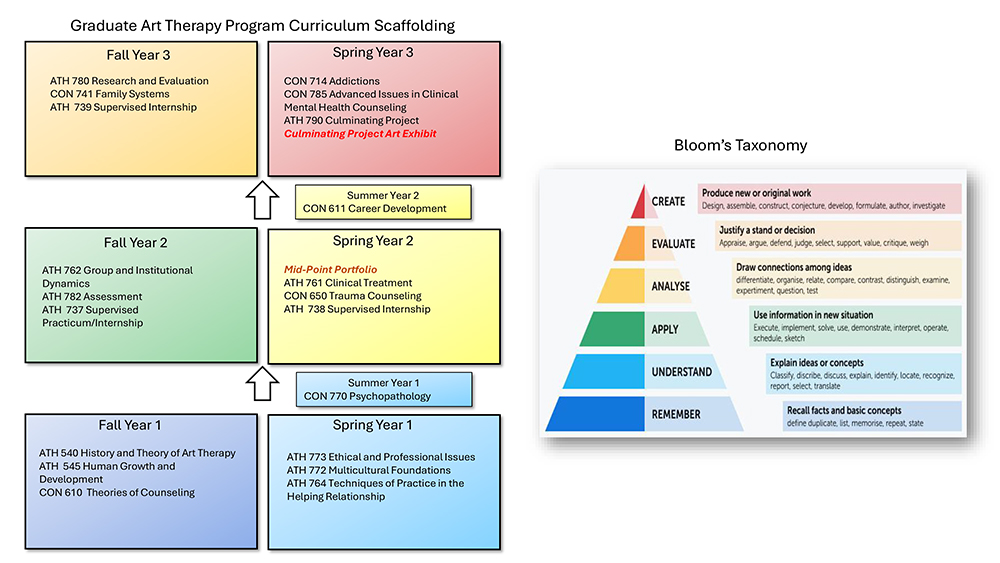
See complete degree requirements and a listing of courses in the Graduate Bulletin (PDF).
Practicum and Internship Experiences
For your required supervised practicum and internship experiences, you will work in a variety of clinical, educational and community settings where art therapists and counselors work. These settings include, but are not limited to, psychiatric and residential treatment facilities, medical art therapy clinics, alternative schools, domestic violence shelters, skilled nursing care centers, alcohol/substance abuse treatment centers, community arts programs, correctional facilities and veteran’s hospitals.
Transfer Credits
A maximum of 9 credits or 30 percent of total program credits, whichever is greater, may be transferred from other regionally accredited institutions with the approval of the program director. All transfer credits must be at a grade B or better, and must be documented with official transcripts. Credit earned prior to admission will be evaluated during the admission process only.
To practice as a certified art therapist, you must have a master’s degree in art therapy or a related field, pass a written exam and complete more than 1,000 hours of direct client contact hours after receiving your master’s degree. The Art Therapy Credentials Board is the recognized body that grants credentials to art therapists. You can become a registered art therapist (ATR) and/or board-certified art therapist (ATR-BC). State regulations for private practice vary by state.
The Mount Mary University graduate art therapy program is accredited by the Commission on Accreditation of Allied Health Education Programs upon the recommendation of The Accreditation Council for Art Therapy Education. Mount Mary’s art therapy program is the only accredited art therapy graduate degree program in Wisconsin.
 |
 |
**The graduate Art Therapy program at Mount Mary University has received official confirmation that it is an approved 60 Credit educational program in professional counseling in the state of Wisconsin. The professional counselor section of the Joint Board of Marriage and Family Therapy, Professional Counseling and Social Work has determined that the Mount Mary graduate art therapy program has met the educational requirements needed for licensure per MPSW 14.01 of the Wisconsin Administrative Code. Applying for approval does not guarantee that approval will be granted. Although the MMU art therapy program meets the requirements for equivalency requirement criteria for a degree in professional counseling as a related profession in the state of Wisconsin, LPC eligibility may vary state by state. For more information about state-by-state licensing efforts for art therapy, see the following link: https://arttherapy.org/state-advocacy
Heather Leigh, DAT, ATR-BC, LCPC
Associate Professor, Art Therapy
Art Therapy Department Chair
Program Director, Graduate Art Therapy
Email: leighh@mtmary.edu
Expertise: Adlerian theory and art therapy, signature pedagogies for art therapy, art therapy with elders, and community building using art
Chris Belkofer, Ph.D., ATR-BC, LPC
Director of Clinical Training, Graduate Art Therapy Program
Email: belkofec@mtmary.edu
Phone: (414) 930-3120
Office: Fidelis Hall 142
Expertise: Art therapy and neuroscience, digital media and art therapy, child and adolescent treatment, PTSD and trauma, neuroaesthetics
To be eligible for the Mount Mary University Master of Science in Art Therapy program, you must meet the following requirements:
- Have a bachelor’s degree in psychology or a related field
- Have completed the prerequisite coursework in art and psychology (see details below)
- Have a minimum undergraduate GPA of 3.0 on a 4.0 scale
- Submit all required application materials (see details below)
International students: See additional application requirements and procedures or contact your graduate admission counselor for questions. (Additional application requirements)
Prerequisite Coursework
The art therapy profession is founded on art and psychology. You must complete prerequisite coursework before full admission to the program is granted. The following is the prerequisite coursework:
- Studio Arts (minimum of 18 credits): This includes courses such as design, drawing, painting, ceramics, sculpture, 3-D design or other electives in studio art.
- Psychology (minimum of 12 credits): This includes courses in general psychology, developmental psychology, abnormal psychology, personality (recommended) or electives in psychology.
The application deadline is January 15. Applications completed by January 15 will be reviewed and qualified candidates will complete an interview with art therapy faculty. Admission decisions will be made after completion of the interview. Applications completed after the January 15 deadline will be reviewed on a case-by-case basis dependent upon program capacity.
How to Apply
- Complete and submit the online Graduate Student Application.
- Submit the nonrefundable application fee ($45 for domestic students). You can submit the payment online by credit card or e-check through the application portal. Note: The application fee is waived for Mount Mary alumni. Contact your graduate admission counselor to obtain the waiver code for alumni.
- Submit your official transcripts from all colleges or universities attended. You will need to contact each institution (typically the registrar’s office) to have your transcript sent directly to Mount Mary University. If you are in the process of completing a bachelor’s degree, send your current transcript at the time of application and then send your final transcript once your degree is conferred. If you previously attended Mount Mary, you do not need to request Mount Mary transcripts, but you should provide transcripts from other schools, if applicable. Official transcripts can be submitted via mail or electronically to:
- Graduate Admission Office, Mount Mary University, 2900 N. Menomonee River Parkway, Milwaukee, WI 53222-4597
- mmu-admissop@mtmary.edu
- Submit three letters of recommendation. The recommendations should be a reference person who can speak to your potential for graduate study. Recommendation forms and instructions are included in the Graduate Student Application.
- Submit an artwork portfolio. The portfolio should include 15-20 images (submitted via flash drive, web-based portfolio, PDF, or PowerPoint) in at least three studio areas confirming your range of media competence and creativity and should include work in two-dimensions, three-dimensions and color.
- Write and submit a career goals statement. The two- to five-page statement should specify your professional skills, your reason for pursuing professional education in art therapy and past experiences contributing to your decision to pursue this course of study. Please include your name on the statement. Using APA format for publication is advised.
- Provide a sample of written academic work. Submit at least one academic paper for review. A paper in art therapy or a related art such as psychology or education is acceptable.
Application materials can be uploaded via the application portal or sent via postal mail or email to:
- Graduate Admission Office, Mount Mary University, 2900 N. Menomonee River Parkway, Milwaukee, WI 53222-4597
- mmu-admissop@mtmary.edu
The Art Therapy program director will contact qualified applicants to schedule an interview. Final admission decisions will be made after all application materials are received and the interview is completed.
According to O*NET OnLine (sponsored by the U.S. Department of Labor), the occupation of art therapist has a “bright outlook” with a median annual wage for counseling and therapeutic occupations is $65,010. As an art therapist, you’ll get to make a difference in the lives of others, sharing your passion for helping and your commitment to social justice through integrity, professionalism and dedication. Master’s level art therapists plan or conduct art therapy sessions or programs to improve clients' physical, cognitive, or emotional well-being.
YOUR FUTURE STARTS HERE
Ready to do more than earn a degree? At Mount Mary, you'll gain the confidence and skills to create a meaningful life and drive real change. Take the first step—apply today and start shaping your future with purpose!
FINANCIAL AID
Worried about tuition costs? Financial aid is simpler than you think and within reach! Mount Mary a variety of scholarships available for students with additional opportunities for state and federal assistance. Take the first step today!